
ChatGPT Traffic Converts 31% Better than Non-Branded Organic Search (94 eCommerce Sites Analyzed)
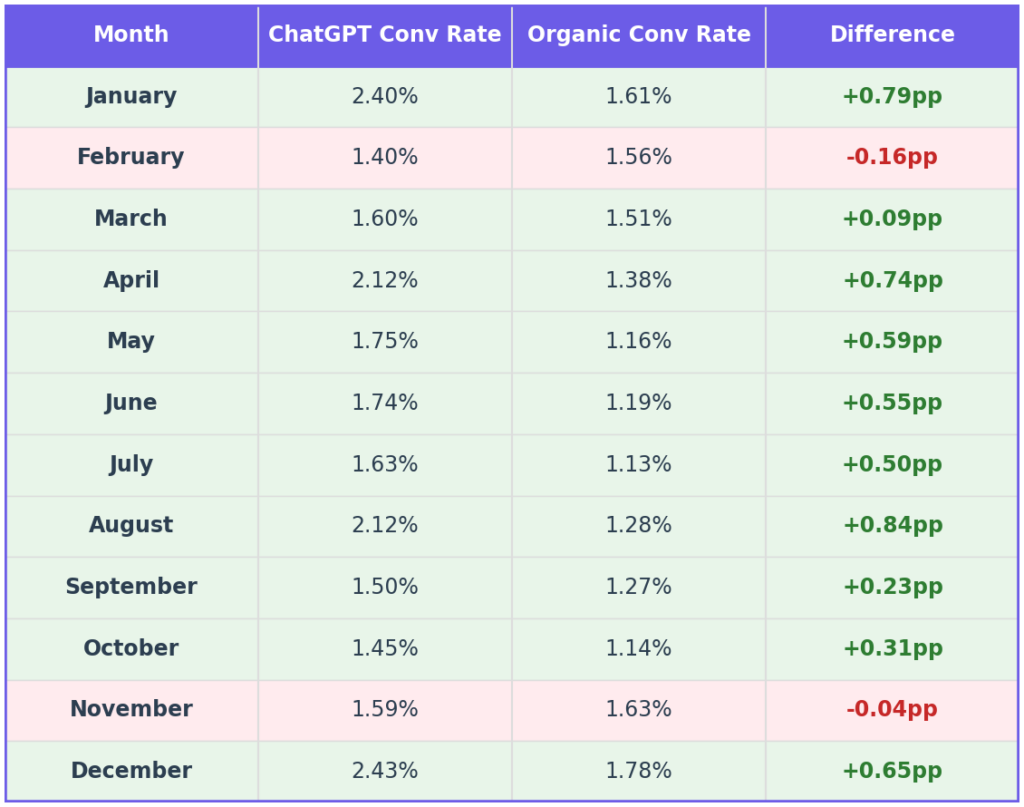
We analyzed 12 months of Google Analytics data across 94 eCommerce stores and found that ChatGPT traffic converts 31% better than non-branded organic search (1.81% vs 1.39%).
But the full picture is more nuanced. Non-branded organic search traffic is still 70x larger than ChatGPT throughout 2025, although this dropped to just 47x in Q4.
Key findings
- Higher conversion rate: ChatGPT traffic converted at 1.81% vs non-branded organic’s 1.39%, an increase of 31%.
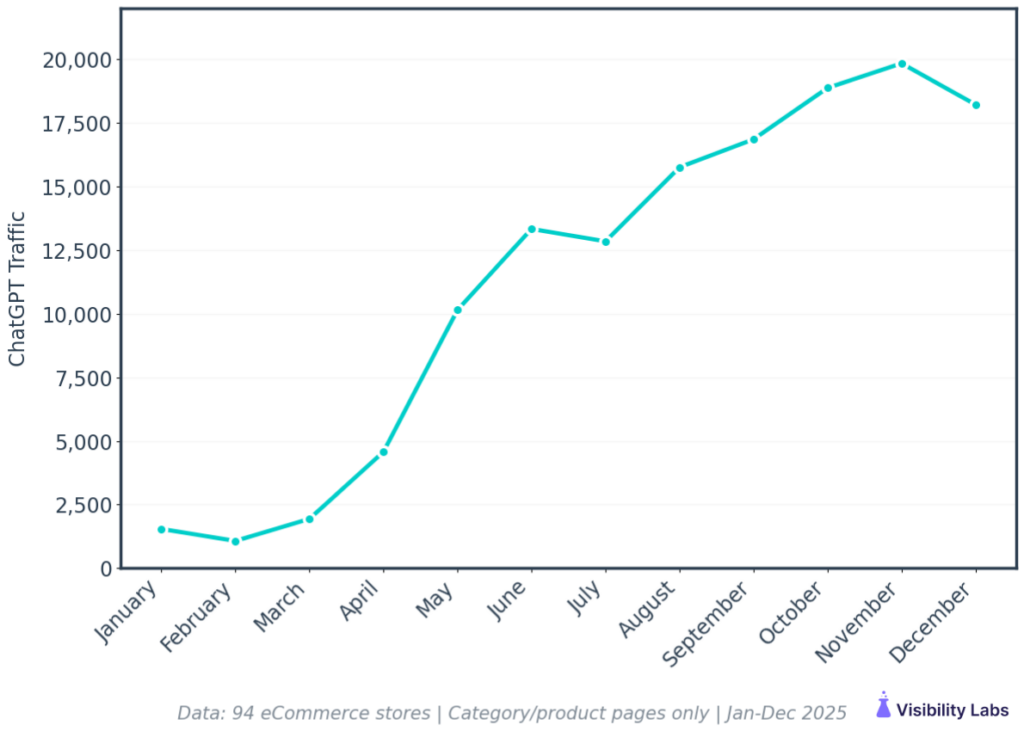
- Massive traffic growth: ChatGPT visits grew 1,079% over the 12-month period (1,544 visits in January 2025 to 18,202 in December 2025). Non-branded organic search only grew 17% during the same 12-month period, most likely due to holiday shopping.
- Lower AOV: Average order value for ChatGPT traffic was $204 vs. organic’s $238, a difference of -14.3%
- Slightly higher revenue per session: Revenue per session was +10.3% higher for ChatGPT, $3.65 per session for ChatGPT vs. $3.30 for non-branded organic search.
- Still a tiny share of revenue: ChatGPT generated $474K vs. organic’s $32.1M, just 1.48% of non-branded organic search revenue. Although this grew to 2.2% in the second half of 2025.
Methodology
We analyzed 12 months of GA4 data (January – December 2025) from 94 eCommerce stores .
- Sample size: 94 eCommerce stores across various verticals
- Total organic sessions: 9.46M generating $32.1M in revenue
- Total ChatGPT sessions: 135K generating $474K in revenue
- Revenue range: 7- 8 figure eCommerce brands
For this study, we intentionally excluded homepage traffic (mostly branded, inflates conversion rates) and blog posts (informational, deflates conversion rates) when analyzing organic search. This kept the comparison focused on commercial intent traffic or visitors actually looking to evaluate and purchase products.
1. ChatGPT traffic converts 31% better than organic
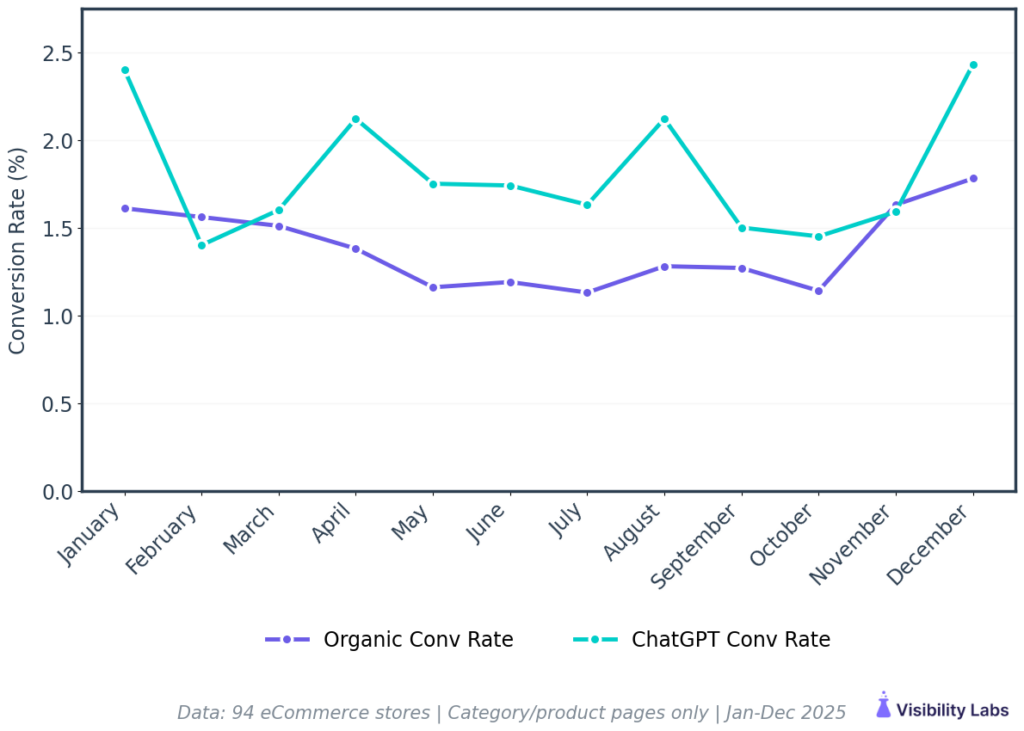
ChatGPT traffic converted better than organic search in 10 of 12 months, with a 12-month average of 1.81% vs. 1.39%.
Why does ChatGPT traffic convert better?
The conversion advantage makes sense when you consider the buyer’s journey. ChatGPT users refine their needs through multiple conversations before clicking, essentially compressing the buyer’s journey.
By the time the customer clicks on a product recommendation from ChatGPT, they’re already past the awareness and consideration stages. They arrive ready to evaluate and purchase, not to browse.
In contrast, traditional search users often scan multiple results and bounce between sites before making a purchase. These clicks can be more exploratory and carry less commitment.
2. Traffic grew 1,079%, but growth is decelerating
ChatGPT traffic growth exploded in the first half of 2025, then slowed considerably. The explosive growth is most likely related to the shopping carousels that were added to ChatGPT in April 2025.
Looking at the ChatGPT traffic as a % of non-branded organic search, we can see a similar trend.
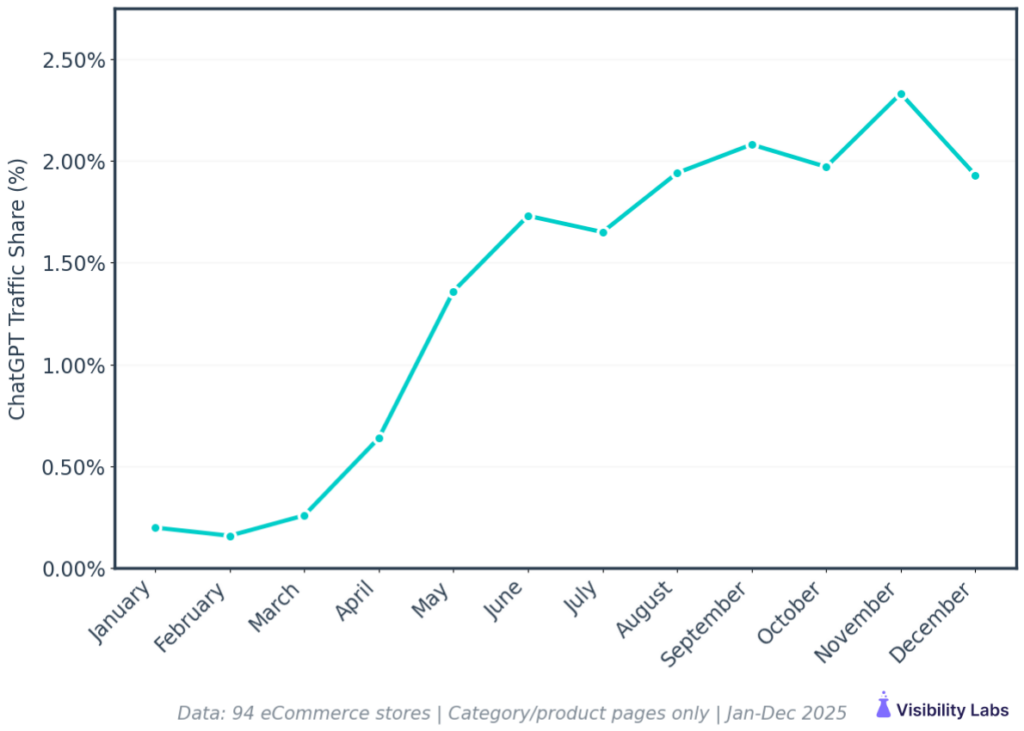
ChatGPT referrals exploded in the first half of 2025 with the release of shopping carousels, but started to flatten out around August.
3. Average order value is -14.3% lower for ChatGPT traffic
Average order value fluctuated significantly for ChatGPT during the first half of 2025.
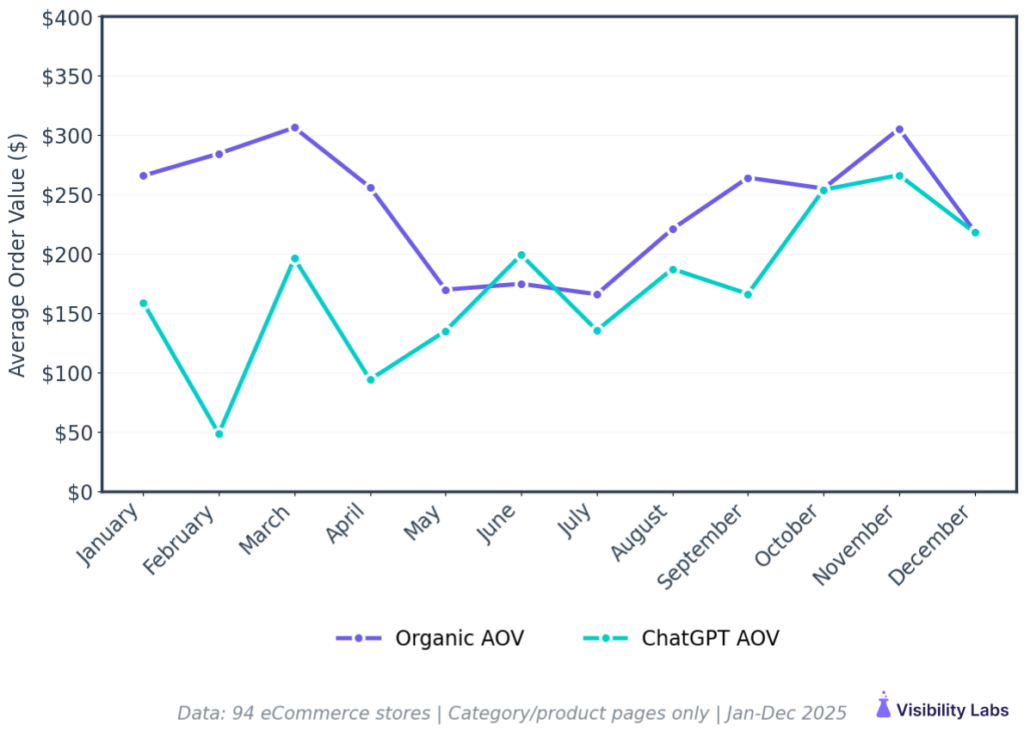
That fluctuations were most likely due to the lack of conversions necessary to be statistically significant. The first few months of 2025 saw just 15-37 conversions directly attributed to ChatGPT.
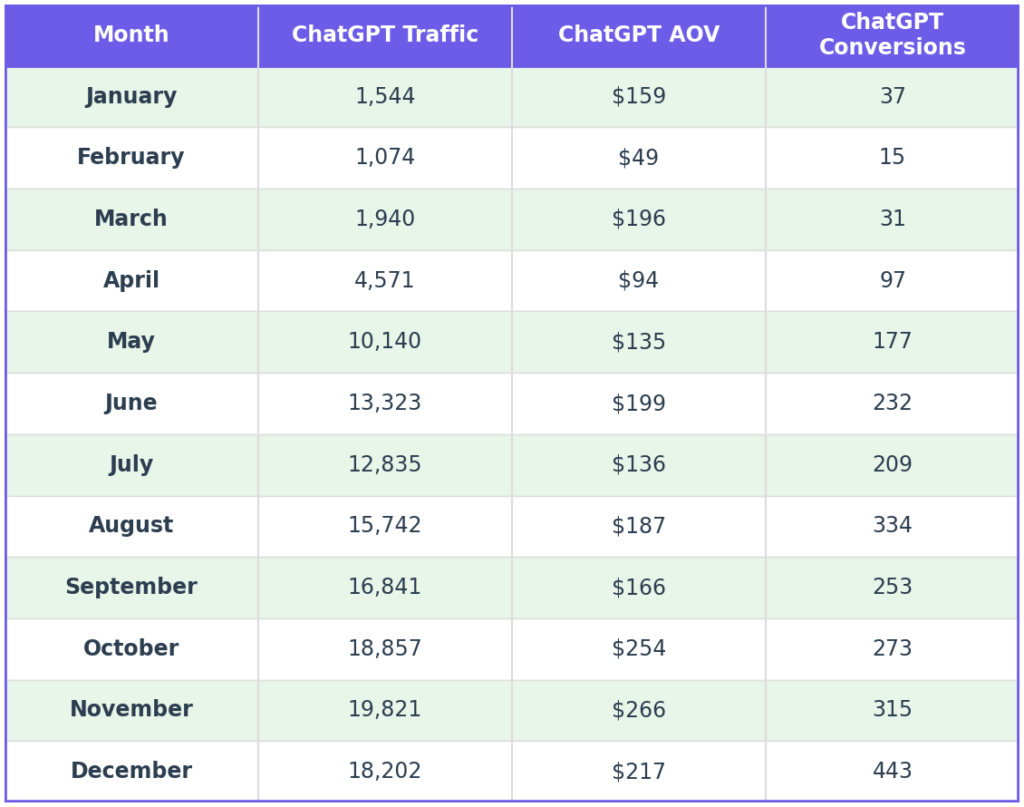
Realistically, it wasn’t until late April 2025 with the release of shopping carousels that traffic and conversions from ChatGPT really picked up.
So if we look at just the 2nd half of 2025, we see -14.3% lower AOVs in ChatGPT vs non-branded organic search ($208 vs $238).
4. Revenue per session is 10.3% higher
Similar to AOV, the first part of 2025 showed high volatility in revenue per session due to a minimal amount of conversions.
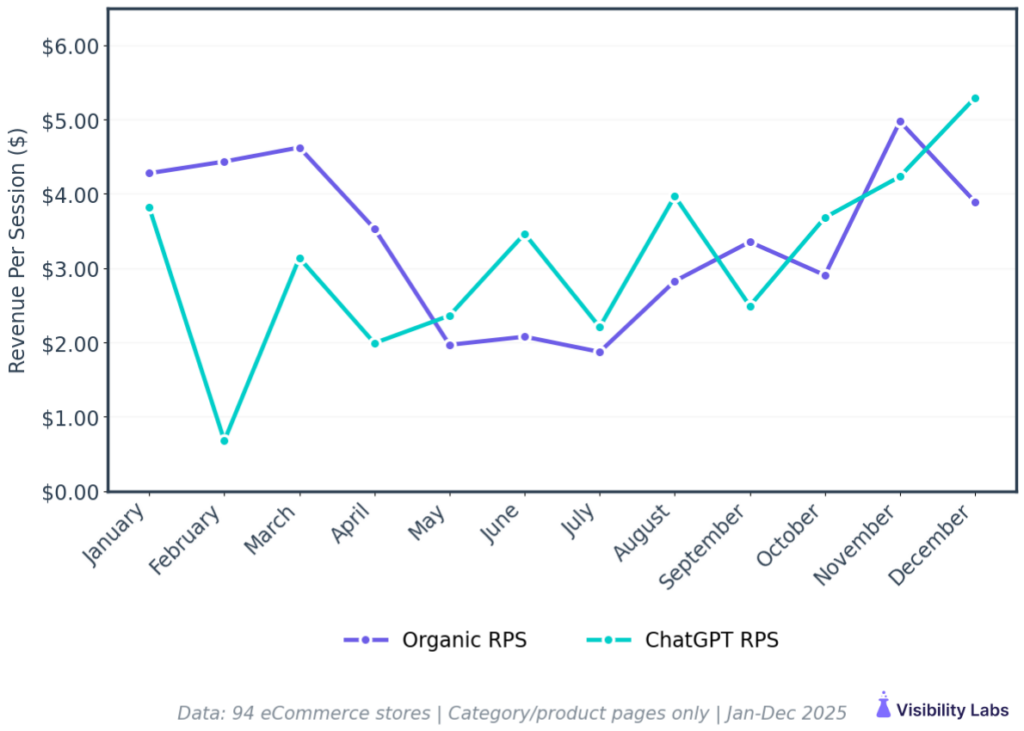
However the second half of 2025 showed much more stability and statistical significance. Revenue per session was 10.3% higher for ChatGPT ($3.65) vs non-branded organic search ($3.30).
Factoring in the increased conversion rates but lower AOV, we end up with just a 10.3% net lift in revenue per session.
Disclaimer: Referral data in GA4 doesn’t tell the full story
This study focuses on ChatGPT referrals tracked in Google Analytics. However in many cases, instead of clicking the links within ChatGPT to visit a website, users are searching the brand or product in Google search. So the ChatGPT funnel often looks something like this.
- User asks ChatGPT for a product recommendation
- ChatGPT recommends products
- User searches the product in Google search
- User visits the website from the search results
- User purchases the product, attributing the sale to organic search (branded)
As a result, there’s likely even more sales that originated in ChatGPT but are showing up as branded search traffic.
For this reason, I always recommend setting up some type of post-purchase survey on the checkout confirmation page asking customers how they found you. Post-purchase surveys can be a more accurate way to determine how important ChatGPT / AI search is for your brand
Final thoughts
The data shows that ChatGPT traffic converts 31% higher than organic search. However due to the slightly lower AOVs, the traffic is only 10.3% more valuable than organic search (non-branded).
But the total number of conversions from ChatGPT might not be fully captured in Google Analytics. So even though the data shows that ChatGPT just accounts for 2.2% of revenue when compared to organic search, the actual amount may be much higher.
If you haven’t already done so, set up post-purchase surveys on your checkout confirmation page. This will give you a much clearer picture of how much value ChatGPT (and other LLMs) are contributing to your business.